Lawn guide · June 9, 2026
The Winter Weeds That Ambush West Tennessee Lawns
Chickweed, henbit, and poa annua sprout in fall and explode in late winter. How winter annuals work in West TN, and why the fix happens in October.
Your bermuda goes to sleep. The weeds don't
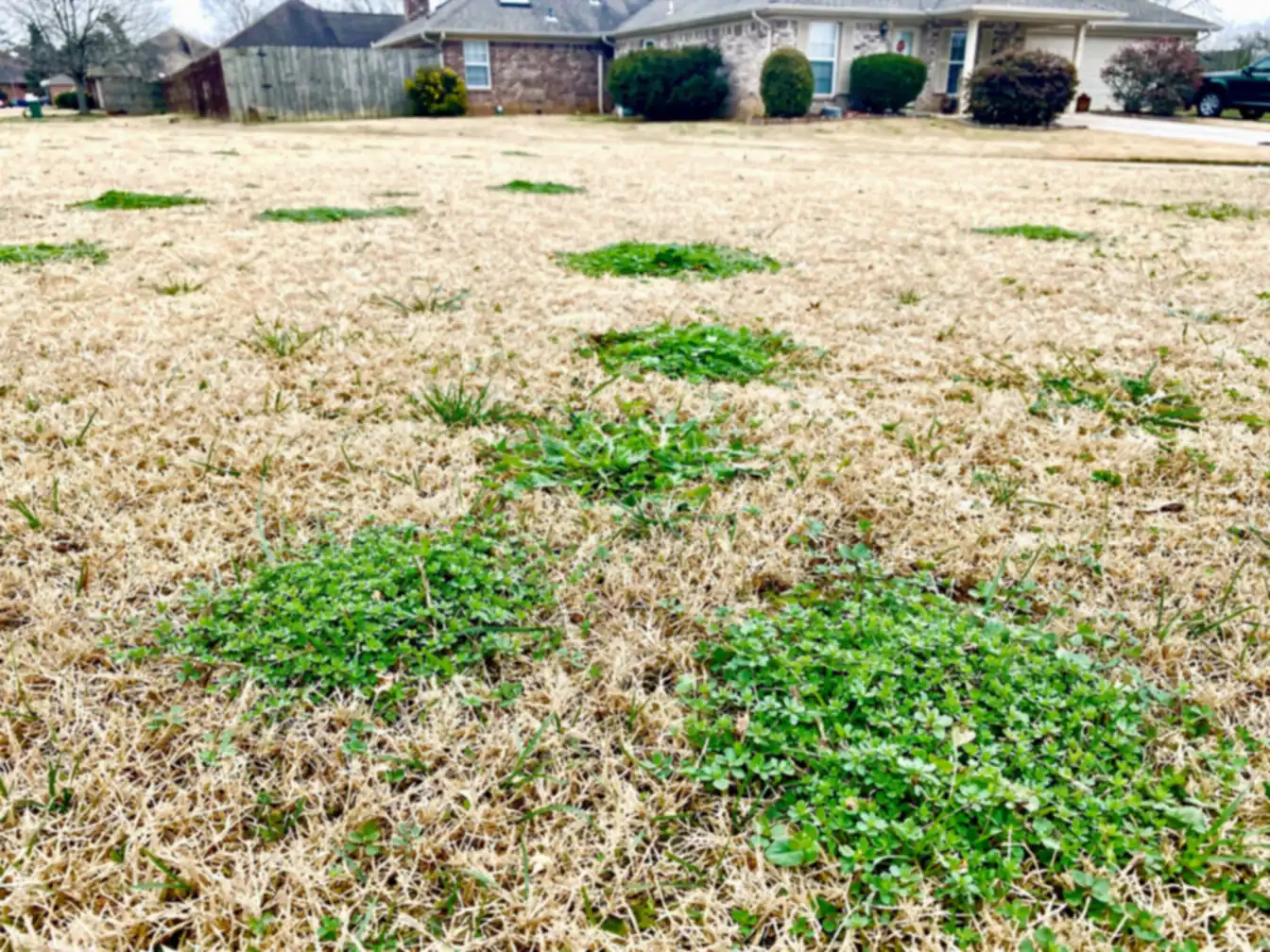
Somewhere around November, every bermuda lawn in Tipton County turns tan and shuts down for the winter. That's normal. Dormancy is how bermuda survives cold weather, and it has done it every year of its life. The trouble is that our winters are mild. West Tennessee sits on the line between zone 7b and 8a, and the soil here rarely stays cold enough to stop everything from growing.
A whole category of weeds, called winter annuals, treats your dormant lawn like an empty parking lot.
Winter annuals run their lives backward from the weeds you fight in summer. They sprout in fall, when soil temperatures cool down out of the summer heat. They grow quietly all winter, low and slow, while your grass sleeps and nobody is looking at the yard. Then in late winter they hit the gas: growing, flowering, and dropping seed like the whole thing was planned. Because it was.
Three weeds pull this trick more than any others around here: chickweed, henbit, and annual bluegrass. Learn these three and you'll be able to name most of the green you see in a brown January lawn.
Chickweed: the quiet takeover
Chickweed forms low, sprawling mats of bright green. Soft little leaves, thin stems, tiny white flowers shaped like stars. It looks harmless. It is not.
A single chickweed plant can drop thousands of seeds, and it doesn't wait for spring to do it. A warm spell in January is enough to get it blooming. The mats spread a little wider every mild week, and because they hug the ground, the mower never touches them. By the time most folks notice chickweed, it isn't a plant anymore. It's a carpet.
Chickweed loves the damp, shaded, cool conditions our winters serve up daily. In a thick summer lawn it wouldn't stand a chance. In a dormant one, nothing is competing with it at all. It's especially fond of the moist edges of the yard, along beds and downspouts and the north side of the house, and it will happily climb right over the top of dormant bermuda like the grass is furniture.
Henbit: the purple one
If you've ever watched a yard or a fallow field turn purple in late February, you've met henbit. It has square stems (roll one between your fingers and you can feel the corners), scalloped leaves, and little purple trumpet-shaped flowers stacked up the stem.
Henbit is the weed that fools people, because it photographs well. Whole pastures of it look like somebody planted lavender. But every one of those purple blooms is scattering seed for next fall's crop, and a plant that sprouted as a speck in October can be a foot-wide clump by bloom time. It's not decorating your lawn. It's mailing next winter's problem to your own address.
Annual bluegrass: the impostor
Poa annua is the sneakiest of the three because it's a grass, so it hides in plain sight. Look for clumps of soft, lighter-green blades standing out against dormant tan bermuda. By late winter each clump tops itself with whitish seed heads, even when it's been mowed short. That's the giveaway. Almost nothing else makes seed heads at half an inch tall.
Here's the part that makes poa annua a double problem. It's a winter annual, so when real heat arrives in May and June, it dies. All those green clumps turn brown and melt away, and they leave bare patches behind at the exact moment crabgrass seeds are hunting for open soil. Poa doesn't just crowd your lawn all winter. It hands its spot to the next weed on the schedule, like a relay team where every runner is bad news.
The honorable mentions
Two more regulars deserve a nod. Wild onion and wild garlic show up as tall, thin, dark-green shoots scattered through the dormant lawn, and if you mow over a patch you'll smell exactly what they are. These two break the winter-annual rules: they grow from little underground bulbs, not from seed, which means pre-emergent can't prevent them and pulling them fails almost every time, because the bulb stays behind in the soil and cheerfully sends up a fresh round of shoots. They take repeated targeted treatments through the winter, hitting the tops hard enough, often enough, to wear the bulb out.
And dandelions, which most folks file under spring, actually get started in fall too and sit through winter as low flat rosettes, ready to launch their yellow flowers at the first stretch of warm weather. The rosette stage, before any blooms, is exactly when they're easiest to kill.
Why late winter feels like an ambush
The calls about winter weeds almost always come in February or March, and the question is always the same: where did all this come from overnight?
It didn't. It came in October.
These weeds germinate in fall and spend the cold months small and easy to miss, especially in a lawn that's brown anyway. A henbit seedling in November is the size of a fingernail. Nobody is out inspecting the yard on a 38-degree December morning, and the weeds are counting on that. Then late winter brings longer days and warm spells, and everything that's been idling for months grows and blooms at once. What looked like a few green freckles in late November is a quarter of the yard by mid-February. Winter annuals aren't fast weeds. They're early ones, and early wins.
There's a flip side worth seeing, too. A dormant lawn can still be the best-looking one on the street. Tan bermuda in January is healthy bermuda, asleep and storing energy in its roots. The real difference between winter lawns isn't the brown. It's what's growing in the brown. An untreated yard fills up with green patches all winter long, while a protected one sleeps clean and wakes up in spring without a fight already underway.
The real fix happens in the fall
Because these weeds start from seed every autumn, the cleanest way to beat them is to never let them sprout. That's a fall pre-emergent application, put down in early September, before soil temperatures drop into the germination range — annual bluegrass is already sprouting by October, so this is not a window to round off. It sets up a barrier in the top layer of soil that stops those fall-sprouting seeds from ever establishing. One well-timed application prevents most of the winter mess before it exists.
If the fall window is already gone, all is not lost. Winter post-emergent treatments can take out chickweed, henbit, and poa annua that are already up and growing. A dormant lawn actually makes this easier: the targets are green, the bermuda is asleep, and there's little risk of hurting grass that isn't actively growing. The goal is to kill each plant before it blooms, because every plant stopped before seeding is thousands of seeds that never make it into your soil.
What doesn't work is waiting until April. By then the weeds have seeded, the lawn has already paid the price, and the plants die on their own schedule anyway, taking a bow like the whole thing was your idea.
One more thing. Winter annuals are opportunists. They thrive in lawns that are thin, hungry, or bare underneath, because open soil in October is an open invitation. A bermuda lawn that goes into dormancy thick and healthy gives fall seeds very little room to land.
So the long game against winter weeds looks a lot like the long game against every weed: fall pre-emergent to lock the door, winter spot treatments to catch what slips through, and feeding through the growing season so the lawn itself does more of the defending. Do that for a couple of seasons and a January yard can be exactly what it should be. Brown, quiet, and boring, in the best possible way.