
How to spot it
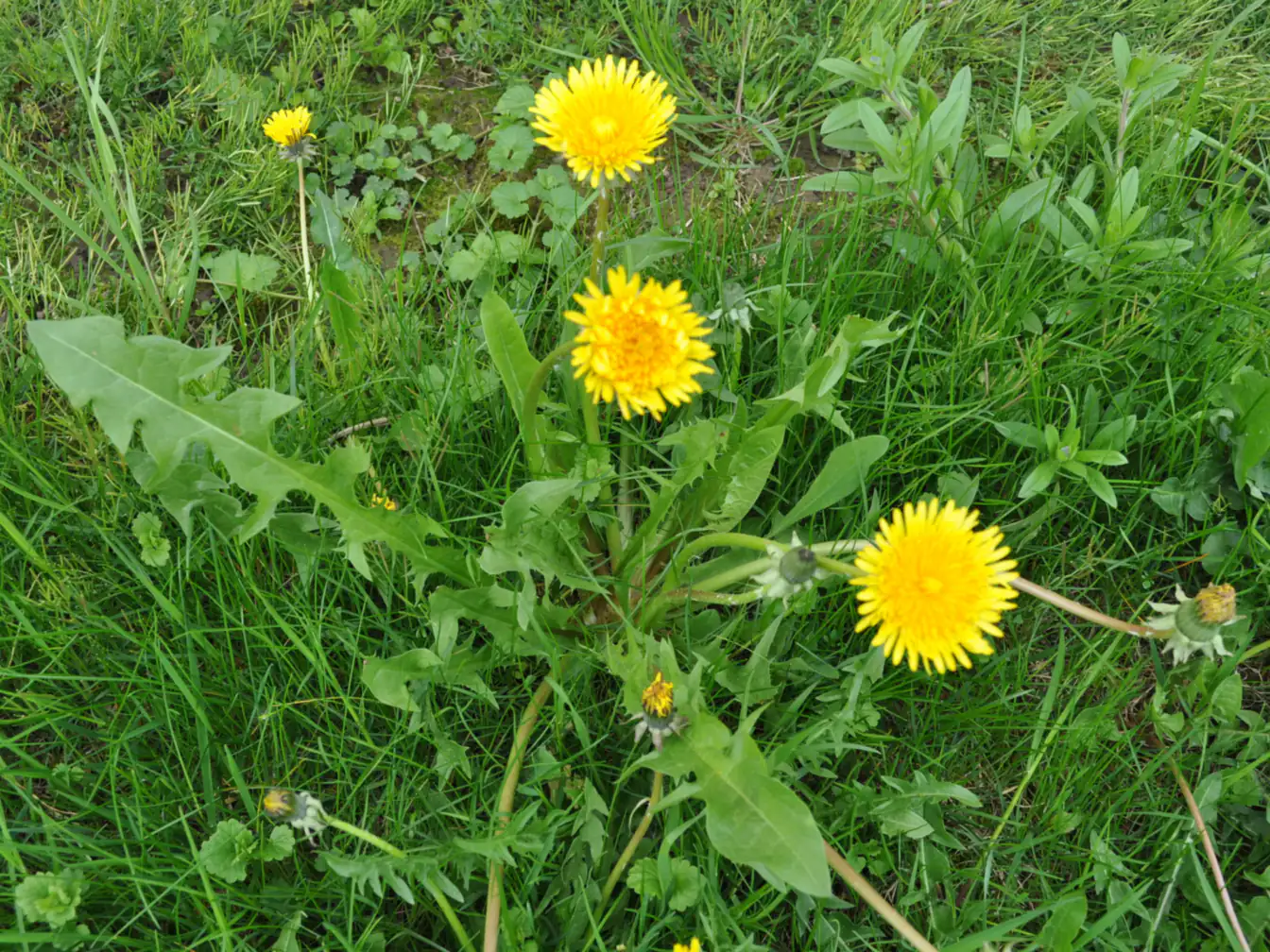
Dandelions are honest weeds — they announce themselves. In late winter and spring you get the bright yellow flower, one per hollow stem, standing above a flat rosette of leaves. Then the flower turns into the gray puffball, and every kid and every breeze in the neighborhood handles distribution from there.
Before it blooms, look for the rosette: long, jagged leaves with backward-pointing teeth, all radiating from one center point pressed flat against the lawn. Snap a leaf or stem and it bleeds milky white sap. What you can't see is the part that matters — a thick taproot, shaped like a skinny carrot, driving down eight inches or more into the packed subsoil. That root is the whole problem.
Its life cycle
Dandelions are true perennials. The taproot lives for years, sending up a fresh rosette whenever conditions allow — heaviest bloom comes in spring, often with a second, smaller show in fall. Seeds ride the wind in from anywhere, germinate in thin or bare soil almost any month that isn't frozen or scorching, and a new plant can be anchored by a serious taproot within its first season. Break the root pulling it, and the piece left behind grows a whole new plant.
Why it loves West Tennessee
Our mild winters mean dandelion rosettes stay alive and photosynthesizing most of the year, and our early springs give them a long bloom window before bermuda fully wakes up and crowds the surface. Dense ground doesn't bother a taproot built for drilling — if anything, compacted soil that thins out the turf hands dandelions exactly the openings their windborne seed is looking for.
Keeping it out
You can't fence out windblown seed, so prevention is mostly about landing conditions. Dense turf is the real barrier — seed that lands on thick bermuda rarely reaches soil. That's the quiet benefit of a full treatment program: fertilization and weed control keep the canopy closed, and fall pre-emergent reduces the seedlings that try to establish in cool weather. The fewer that ever anchor a taproot, the easier every following year gets.
Getting it gone
The fix is a systemic broadleaf treatment — one that gets absorbed by the leaves and travels all the way down the taproot, killing the plant from flower to tip. Surface damage isn't enough; that's why snapping them off by hand turns one dandelion into a hobby. Timing does real work here: treating in spring before the puffball stage stops hundreds of future plants, and fall applications are quietly even more effective, because the plant is pulling energy — and the treatment with it — down into the root for winter. Established lawns usually need spot treatment, not blanket spraying.
Don’t confuse it with
A few yellow-flowered imposters show up in spring. Carolina false dandelion runs taller with branched, wiry flower stems, and cat's-ear has fuzzy leaves where dandelion's are smooth. Quick check: true dandelion has exactly one flower per stem, and the stem is hollow and leafless. Treatment is similar either way, so no harm done if you guess wrong at the curb.