How to spot it
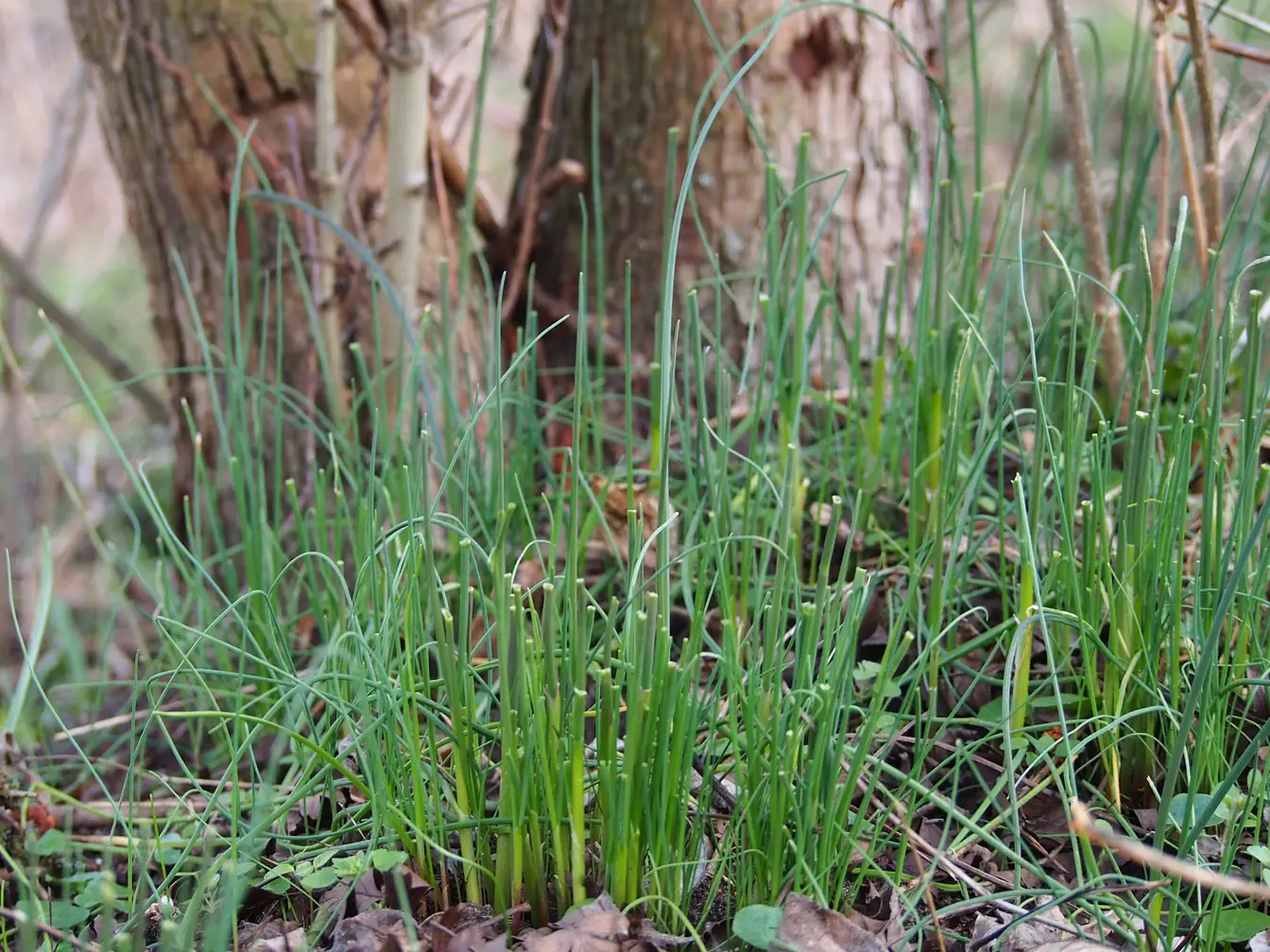
You'll usually smell this one before you kneel down. Wild onion and its near-twin wild garlic show up in winter as clusters of tall, thin, dark green shoots standing straight up out of a flat dormant lawn — like somebody planted chives in your yard. The shoots are glossy, slick to the touch, and grow faster than anything around them. Crush one between your fingers and there's no doubt: that's onion.
Check the base and you'll find the shoots rising in bunches from one spot. That's because each cluster grows from underground bulbs, often several packed together an inch or three down in the soil. The clumps tend to come back in the same places year after year — same corner of the yard, same spot by the fence — because the bulbs never left.
Its life cycle
Wild onion is a perennial that works the night shift. The bulbs sit dormant through summer, send up shoots in fall, grow all winter and spring, and then die back to the bulb when heat arrives. Underground, each parent bulb produces offset bulblets, so one plant quietly becomes a cluster. Nothing about this system depends on seed — which is exactly why it laughs at the strategies that stop other winter weeds.
Why it loves West Tennessee
Our mild winters give wild onion a long, comfortable growing season while bermuda is dormant and can't compete. Our tight silt loam suits it fine — bulbs sit protected below the surface, insulated from our short cold snaps, and winter moisture keeps the shoots growing. Old pastures and farm ground converted to lawns around Tipton County often came with a bulb population already installed.
Keeping it out
Here's the frustrating truth: pre-emergent does nothing for wild onion, because it doesn't grow from seed. Pulling usually fails too — the shoots snap off and the bulb below sends up replacements, sometimes splitting into more bulblets for your trouble. The best prevention is a thick, healthy lawn that shades the soil, plus treating clumps promptly so bulbs never get a full season of energy to multiply.
Getting it gone
This is a persistence game. Professional control means repeated, targeted post-emergent treatments through winter and early spring, timed while the shoots are actively growing and the bermuda is dormant. The waxy, upright leaves shed spray easily, so application technique matters as much as the product. Each treatment drains the bulb's reserves; hit the regrowth again before it can refuel and the cluster runs out of gas — usually over a season or two, not a single visit. That's why wild onion is handled inside our annual program rather than as a one-shot fix.
Don’t confuse it with
Wild garlic and wild onion get one name in most yards, and the treatment is identical, but there's a difference if you're curious: wild garlic leaves are round and hollow, wild onion's are flat and solid. Star-of-Bethlehem looks similar too — grassy winter clumps from bulbs — but its leaves have a white stripe down the middle and no onion smell. No smell, check twice.