
How to spot it
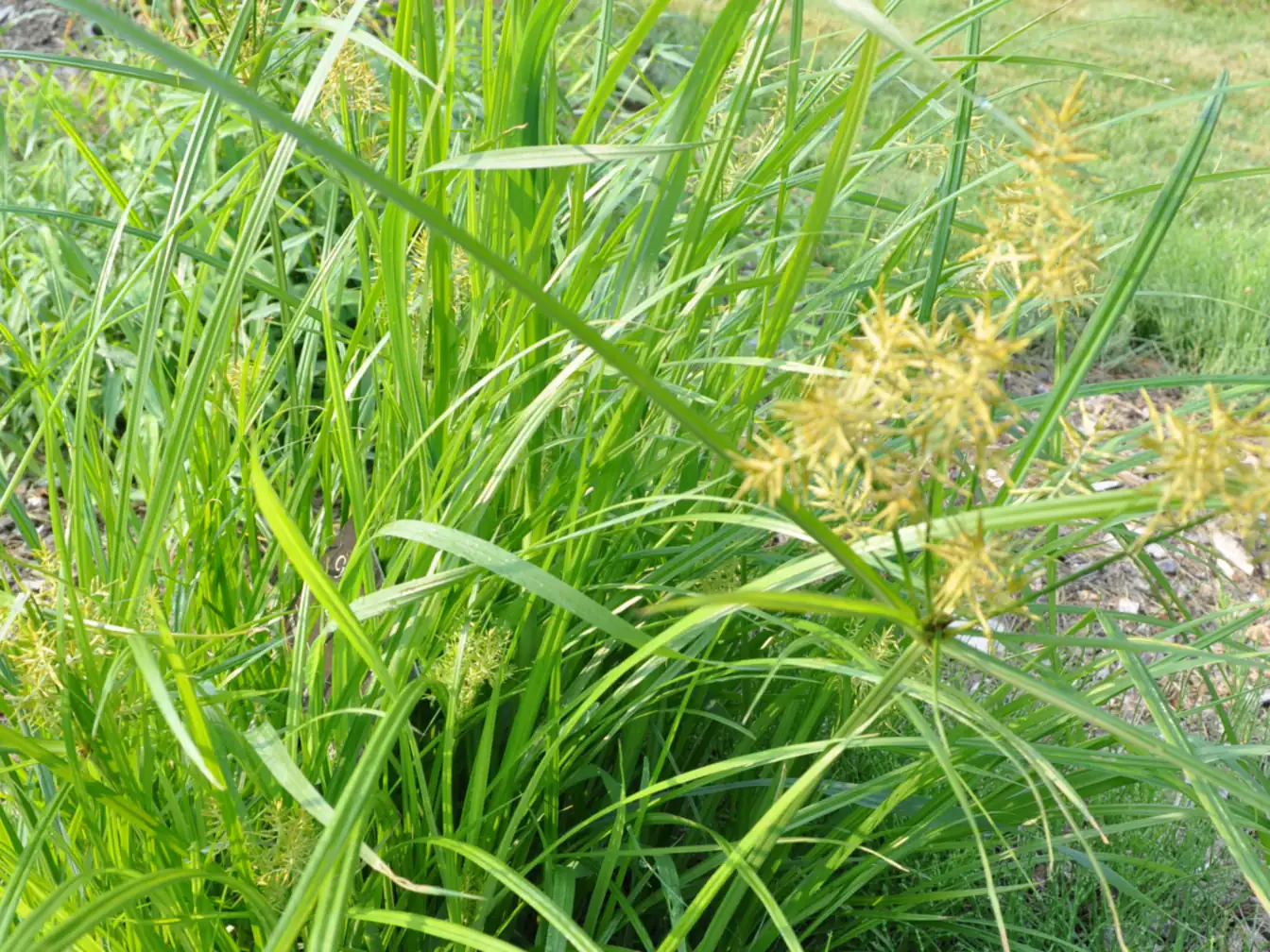
Nutsedge is the tall one. A few days after mowing, it's already standing above the lawn — glossy, yellow-green, growing like it has somewhere to be. The shine is a real clue: nutsedge blades are slick and waxy, brighter and yellower than bermuda, with a crease down the middle.
The clincher is in your fingers. Roll the stem near the base: a grass stem is round or flat, but a nutsedge stem is triangular — you'll feel three distinct edges. Sedges have edges. Leaves also come off the stem in sets of three rather than two. You'll find it worst in the damp parts of the yard: around downspouts, low spots, the strip that never quite dries out. Shiny, tall, triangular, wet feet — that's nutsedge.
Its life cycle
Nutsedge is a perennial that plays the long game underground. Shoots emerge in late spring as soil warms, run hard through the heat of July and August, and die back at frost — but the plant isn't in the shoots. It's in the tubers, little marble-sized "nutlets" formed along underground runners, each one able to sprout a new plant and make more tubers of its own. A single plant can produce hundreds in a season. Pull the shoot and the tuber below just sends another, which is why one plant becomes a widening patch.
Why it loves West Tennessee
Our summers hand nutsedge everything it wants: heat, humidity, and regular thunderstorms landing on silt loam that drains slowly over a dense subsoil layer. Poorly drained and compacted areas stay moist for days after rain, and those are precisely the spots where nutsedge colonies take hold and expand. Meanwhile our winters aren't cold enough deep in the soil to clear out the tuber bank, so each spring starts where last summer left off.
Keeping it out
Standard pre-emergent programs don't stop nutsedge, because most shoots come from tubers, not seed. Prevention is about water and soil: fix drainage where you can, water deep-and-infrequent rather than daily, and use aeration to open up compacted grouy so it stops holding puddles. Dense summer turf helps shade and slow it too — that's part of what the full program is building all year.
Getting it gone
Regular broadleaf and grassy-weed products don't touch nutsedge — it's a sedge, a different plant family, and it needs its own specialized treatment. Professional sedge control is applied to actively growing shoots from early summer through August, while the plant is still pushing hard, and it works systemically, moving down to shut down the tubers rather than just burning the tops. Young infestations may fall in one or two visits; established colonies with a big tuber bank take repeat applications over a season or more, catching each flush as tubers sprout.
Don’t confuse it with
Plenty of tall grassy escapes get called nutsedge, but the triangle settles it — no true grass has that three-edged stem. Yellow nutsedge is the common one here, glossy and yellow-green; purple nutsedge, with darker reddish-purple seed heads, turns up too. Both get the same class of specialized treatment, so from the homeowner side the important call is simply "sedge, not grass."