
How to spot it
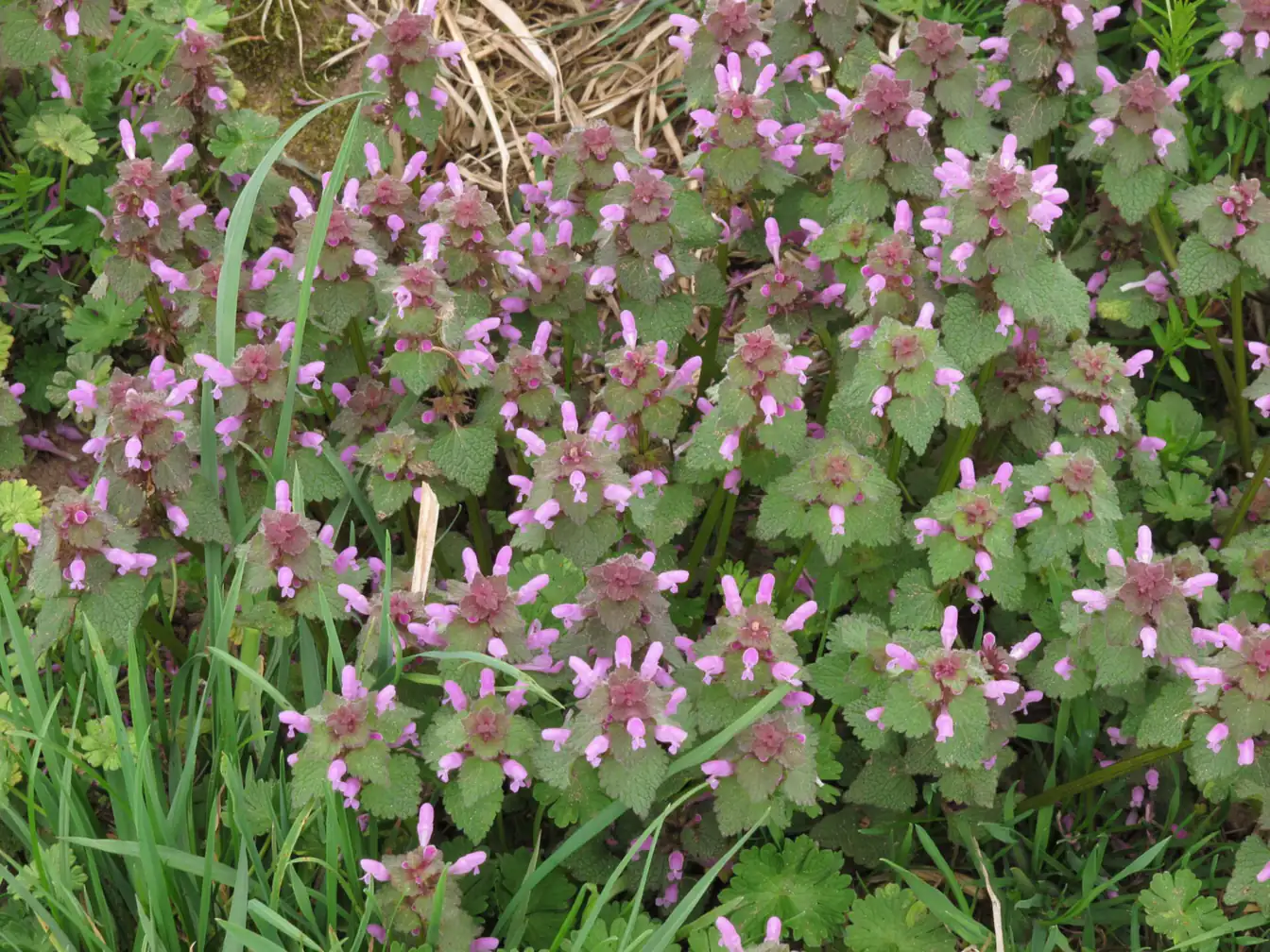
Purple deadnettle is the one that looks purple from the truck. In late winter and early spring it stands up in soft patches, and the top of every stem is stacked with pointed, purple-tinted leaves that droop downward on little stalks — like rows of tiny pagoda roofs. Lower on the plant the leaves stay green and more heart-shaped, so the purple is concentrated up top, which gives whole patches that two-tone look.
Roll a stem between your fingers and you'll feel four corners — square stems, because deadnettle is in the mint family. The leaves are fuzzy, and small pink-purple tube flowers peek out from under the top leaves in early spring. Despite the name, there's no sting; “dead” nettle just means the nettle look without the nettle bite.
Its life cycle
Purple deadnettle is a winter annual: it germinates in fall as the soil cools, grows quietly through our mild winter while the bermuda sleeps, then flowers hard in late winter and early spring. One honest note — those early flowers are some of the first food available to bees coming out of winter, which is a real point in its favor in a field, if not in your lawn. By the time real heat arrives, the plant dies on its own — but not before dropping a heavy load of seed that waits in the soil for fall to start the cycle again.
Why it loves West Tennessee
Our winters are the reason. West Tennessee stays mild enough that winter annuals grow right through January, and a dormant bermuda lawn offers them zero competition — the turf is asleep, tan, and defenseless while deadnettle builds green real estate. It favors thin turf, bed edges, and disturbed soil, and against a dormant lawn those purple-topped patches might as well be flagged. Every plant you see blooming in March is finishing a job it started back in October.
Keeping it out
Winter annuals are beaten in the fall, months before you see them. A fall pre-emergent application — timed as the soil cools, when deadnettle seed is getting ready to germinate — stops the whole spring show before it starts; you can see where that treatment sits in the season on our lawn care calendar. The other half is thick turf going into winter: deadnettle colonizes thin and open ground, so a dense fall lawn leaves the seed nowhere to land.
Getting it gone
Caught small in winter or early spring, deadnettle is not a hard target — broadleaf treatments handle it well while the plant is young, which is exactly when our winter visits go after it as part of weed control. The trap is waiting: by the time the purple tops make it obvious, the plant is days from seeding, and summer heat killing it off can fool you into thinking you won. The plant dies either way; the difference is whether it banked thousands of seeds for the fall rematch first.
Don’t confuse it with
Its twin is henbit — same mint family, same square stems, same purple flowers, same winter schedule, often the same yard. Look at the upper leaves: deadnettle’s are pointed, purple-tinted, and droop downward on short stalks, while henbit’s stay green and rounded and clasp directly around the stem with no stalk at all. Ground ivy earns a mention too — another square-stemmed creeper — but it’s a perennial that spreads by runners and sticks around all year. Between deadnettle and henbit, the treatment plan is the same, so this is one mix-up that costs you nothing.