
How to spot it
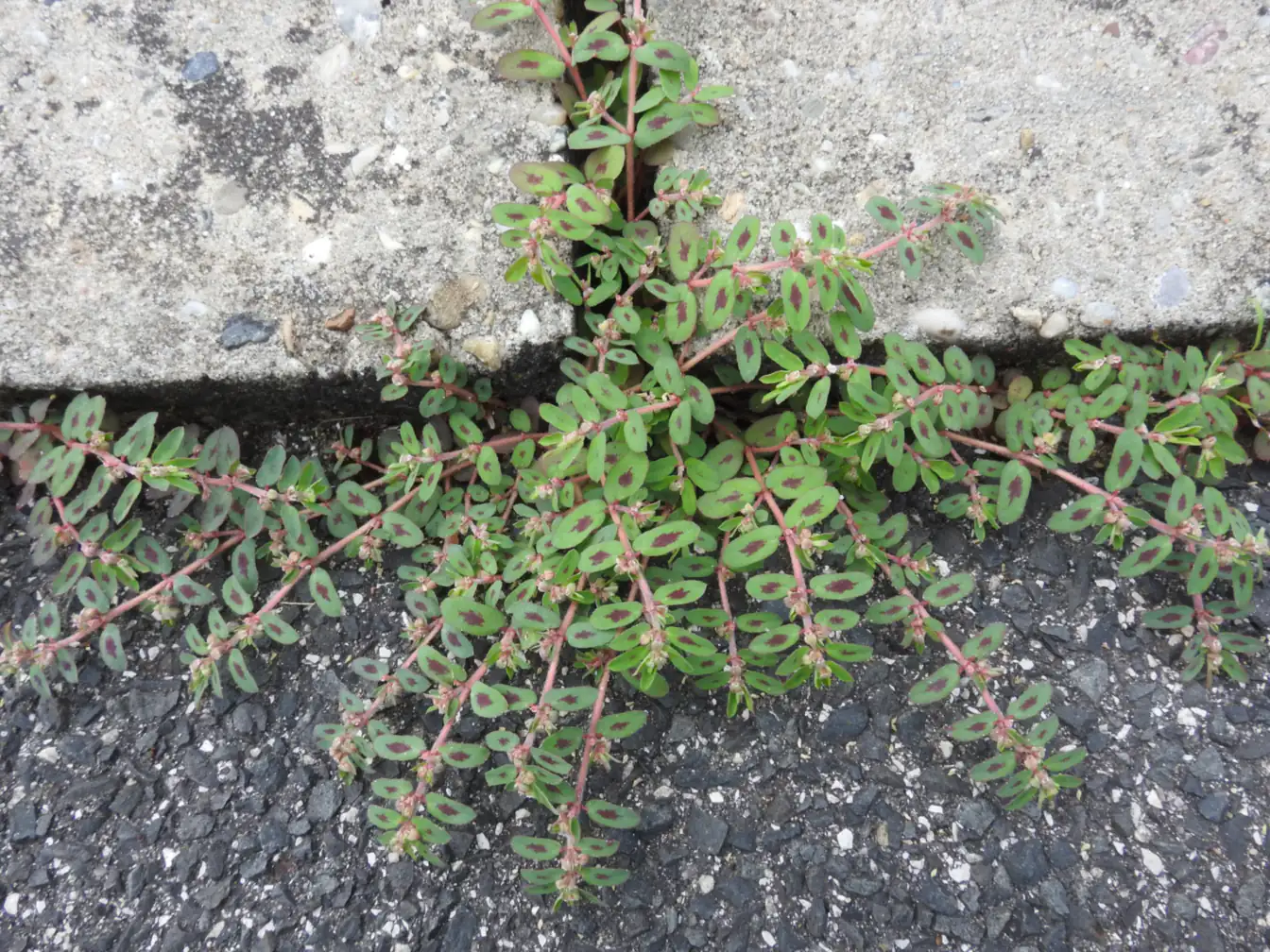
Spurge shows up wherever your lawn is thinnest — and in the hottest spots first. Look along the driveway edge, the sidewalk strip, bare patches, anywhere grass struggles: spurge grows as a flat, ground-hugging mat, spreading out from a central root like a dark green doily pressed against the soil.
The leaves are tiny — pinky-nail small — arranged in neat pairs along reddish stems, and most carry a little maroon blotch in the center, which is where "spotted" spurge gets its name. The definitive test costs you one stem: snap it, and it bleeds milky white sap immediately. (Wash your hands after — the sap can irritate skin.) Flat mat, paired spotted leaves, milky sap: that's spurge.
Its life cycle
Spotted spurge is a summer annual sprinter. Seeds germinate once soil warms into the 60s and keep germinating all summer long, so new mats appear from late spring right through August. Each plant races from seedling to seed production in a matter of weeks, flowering almost as soon as it's established, and one plant can drop several thousand seeds — many of which sprout the same season. Frost kills the plants, but by then the seed bank along your driveway is fully restocked for next June.
Why it loves West Tennessee
Spurge is built for exactly the conditions our summers create. It thrives in heat that stresses turf, shrugs off drought, and actually prefers the baked, compacted ground along pavement where soil temperatures run highest. West Tennessee's long frost-free season gives it months of germination windows, and every patch of bermuda that thins under summer stress becomes an open invitation.
Keeping it out
Two defenses, and the second one matters more. Spring pre-emergent — the same properly timed barrier that handles crabgrass, laid down before soil warms — stops a large share of spurge seed, though late-summer germinators can sneak past thin coverage. The lasting fix is density: spurge is a terrible competitor and simply can't break into thick turf. Feeding, aeration, and mowing bermuda at 1 to 2 inches keep the turf running sideways and the canopy closed; the annual program is what keeps all of that on schedule so the driveway edge stops being easy ground.
Getting it gone
Young spurge is easy to treat and old spurge is annoying, so timing drives everything. Selective broadleaf spot treatment works well on small mats; big mature mats have a waxy, drought-hardened surface that resists spray and often need a follow-up pass. Because new seed keeps sprouting all summer, one treatment in June doesn't end the conversation — professional care means re-checking the hot spots at each visit and catching new mats while they're small. Hand-pulling works on singles if you get the taproot.
Don’t confuse it with
Prostrate knotweed claims the same beat-up ground — driveway edges, compacted paths — with a similar flat, wiry mat. The sap test separates them in two seconds: knotweed snaps clean and dry, spurge bleeds milky white. Purslane also mats in hot thin areas, but it's succulent, with thick fleshy leaves and stems. Milky sap plus spotted leaves means spurge, every time.