How to spot it
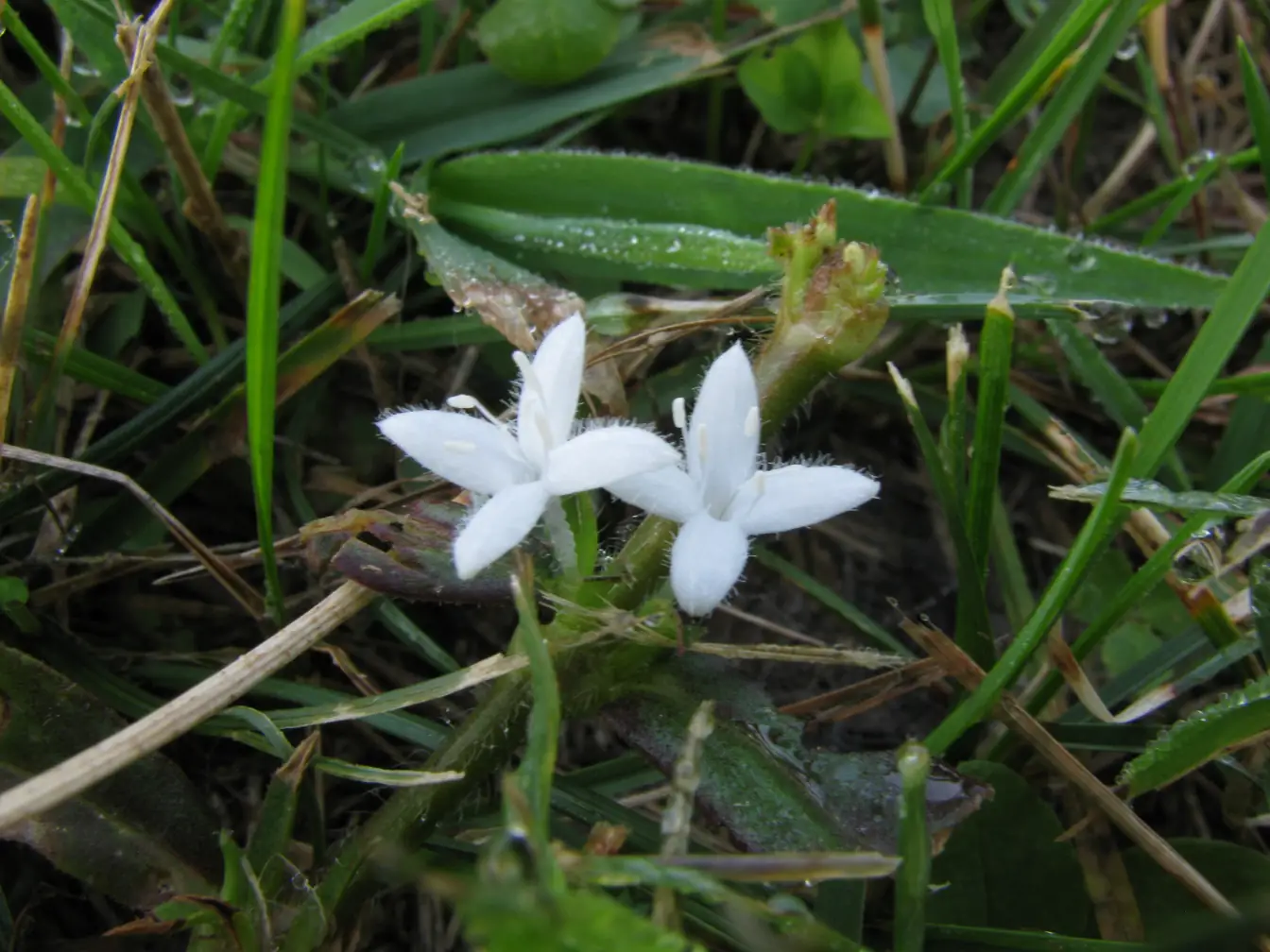
Virginia buttonweed is the mat in the wet spot. It sprawls low through the turf in the dampest parts of the yard — drainage paths, low corners, the strip below the downspout — a tangle of branching stems hugging the ground beneath mowing height. The leaves come in opposite pairs, narrow and lance-shaped, dark green but often streaked with yellow mottling, so a patch can look half-sick even while it's spreading.
The flowers settle it. Tucked right into the leaf joints, down inside the mat, are small white star-shaped flowers with four petals — count them, four, where most lawn flowers run three or five. A low green tangle in a damp area, wearing little white four-point stars along the stems, is Virginia buttonweed — and worth catching at one patch instead of five.
Its life cycle
Buttonweed is a perennial with a deep bench. It grows from a taproot and a network of fleshy roots that ride out winter easily, and the mats regrow from those roots every spring no matter how dead the top looked in December. It spreads three ways at once: creeping stems that root down as they go, seed — including seed set by hidden flowers at and below the soil surface — and stem fragments, which can root wherever they land. That last one matters most, because a mower running through a patch turns every chopped piece into a cutting looking for damp ground. Low mowing doesn't faze it; cut it short and it just hugs tighter.
Why it loves West Tennessee
Buttonweed's favorite thing in the world is wet feet, and our silt loam over a dense subsoil layer delivers exactly that. West Tennessee thunderstorms drop inches of rain on soil that drains slowly, low spots stay damp for days afterward, and irrigated lawns stay damp on schedule. Add mild winters that never freeze deep enough to kill the root system, and a buttonweed patch that establishes here doesn't leave on its own — it just wakes up a little wider every June.
Keeping it out
Pre-emergent won't save you here — established buttonweed returns from perennial roots and rooted fragments, not from a spring seed flush. Prevention is drainage and vigilance: fix the spots where water stands, open up compacted ground so it stops holding puddles, and water deep-and-infrequent instead of a little every day. Catch the first patch while it's one patch, and if you mow through it, bag the clippings there — fragments ride the deck to new ground. Dense, well-fed turf everywhere else denies the mats easy neighbors, which is the season-long work of the annual program.
Getting it gone
We'll level with you: Virginia buttonweed is on the short list of hardest lawn weeds in the South, and nobody promising one-visit results is being straight with you. Post-emergent treatments burn the mats down, but the roots below push back, so real control means repeated, targeted applications through the summer — often across more than one season — hitting the regrowth each time before it rebuilds its reserves. Mid-summer, while the plant is growing hard, is the productive window. Persistence wins this one; drama doesn't.
Don’t confuse it with
Prostrate knotweed makes a similar low mat but works the opposite habitat — dry, beat-down, compacted ground along driveways — and never shows buttonweed's white stars. Doveweed shares the wet spots and passes for a grass, with rubbery, succulent stems and no four-petal flowers. Check the address and the bloom: damp ground plus white four-point stars in the leaf joints means buttonweed. And since control differs completely from either lookalike, this ID is worth thirty seconds on your knees.