
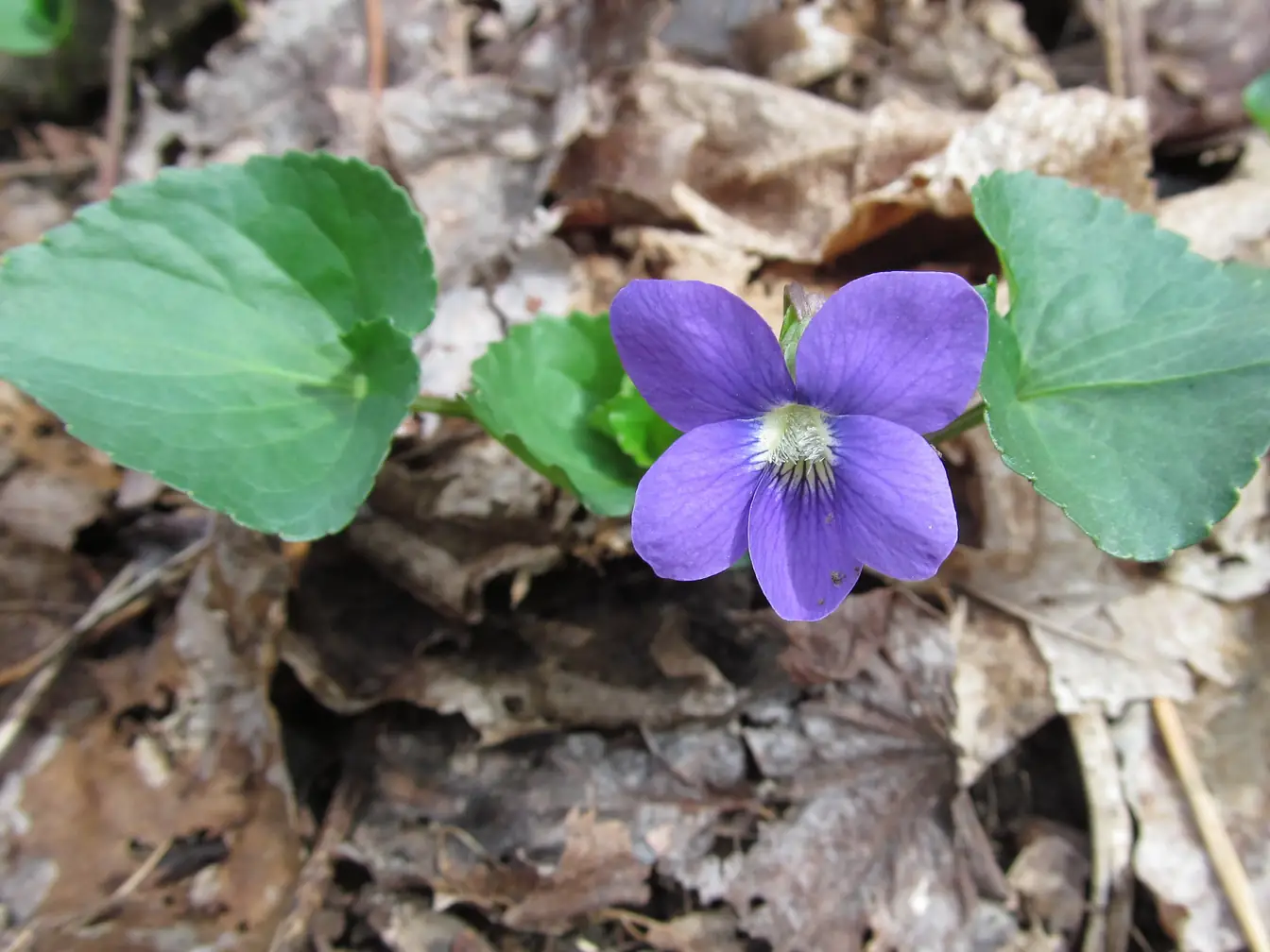
How to spot it
Wild violets are pretty, stubborn, and found where you'd guess: the shady, damp corners of the yard. Look under trees, along the north side of the house, near downspouts — anywhere bermuda already struggles for light. The plants grow in low clumps of heart-shaped leaves, deep green with a glossy, waxy finish, edges finely toothed, rising on individual stalks straight from the ground.
In spring the clumps bloom small purple flowers that would be charming in a flower bed and are less charming advancing across a lawn. Colonies spread as connected patches rather than scattered singles — a few clumps become a solid carpet over two or three seasons. That waxy shine is why violets treat most weed sprays like a raincoat.
Its life cycle
Wild violets are perennials with infrastructure. Below ground they run on thick, fleshy rhizomes — underground stems that store energy, survive winter, and sprout new plants along their length. Leaves emerge in early spring, flowers follow, and — the sneaky part — violets also produce hidden self-pollinating seed pods at ground level that fire seeds outward with no flower required. Between creeping rhizomes and quiet seed production, a patch grows even when it looks like nothing's happening. Top growth may fade in deep summer heat; the rhizomes never do.
Why it loves West Tennessee
Violets exploit the one place bermuda can't defend: shade. Bermuda loves full sun and thins badly under tree canopies, and mature oaks and maples are everywhere in Tipton County yards. Add our silt loam holding moisture in those same shaded, low-evaporation spots, plus mild winters that never kill the rhizomes, and violets get a protected homestead with no real competition.
Keeping it out
Pre-emergent won't stop violets — established patches spread by rhizome, not new seed. Prevention means shrinking their habitat: raise or thin tree canopies where practical to get more light down, improve drainage in damp corners, and keep the surrounding turf as thick as the site allows. Honest note from the weed control side: in deep shade, no grass fully closes the door, so early treatment of the first few clumps matters more here than with almost any other weed.
Getting it gone
Violets are a top-tier challenge, and one-and-done doesn't exist here. That waxy leaf sheds standard sprays, and even a treatment that burns the tops down leaves rhizomes ready to resprout. Professional control uses selective broadleaf products suited to violets, applied for maximum leaf coverage, with fall being the strongest window: the plant is moving energy down into its rhizomes and carries the treatment along with it. Expect follow-up applications across a season or two for mature colonies. Steady beats dramatic with this one.
Don’t confuse it with
Before it flowers, violet gets confused with ground ivy (creeping charlie), which also likes shade and has roundish leaves. Check the shape and habit: violet leaves are heart-shaped and rise from ground-level clumps, while ground ivy has scalloped, rounder leaves on long square stems creeping across the surface — crush one and ground ivy smells faintly minty. The ID just tells us which fight we're in.